


Introduction
Every small business owner wants to be remembered. They want customers to choose them over competitors, recommend them to friends, and come back again and again. This is the promise of great branding and it is entirely achievable for businesses of any size. But there are specific, recurring branding mistakes that consistently undermine small business growth, and many of these mistakes are made before a single customer walks through the door.
The good news is that these mistakes are well documented, entirely avoidable, and correctable even after the fact. Understanding them clearly is the first step to building a brand that actually works as hard as your business does.
Mistake 1: Confusing a Logo with a Brand
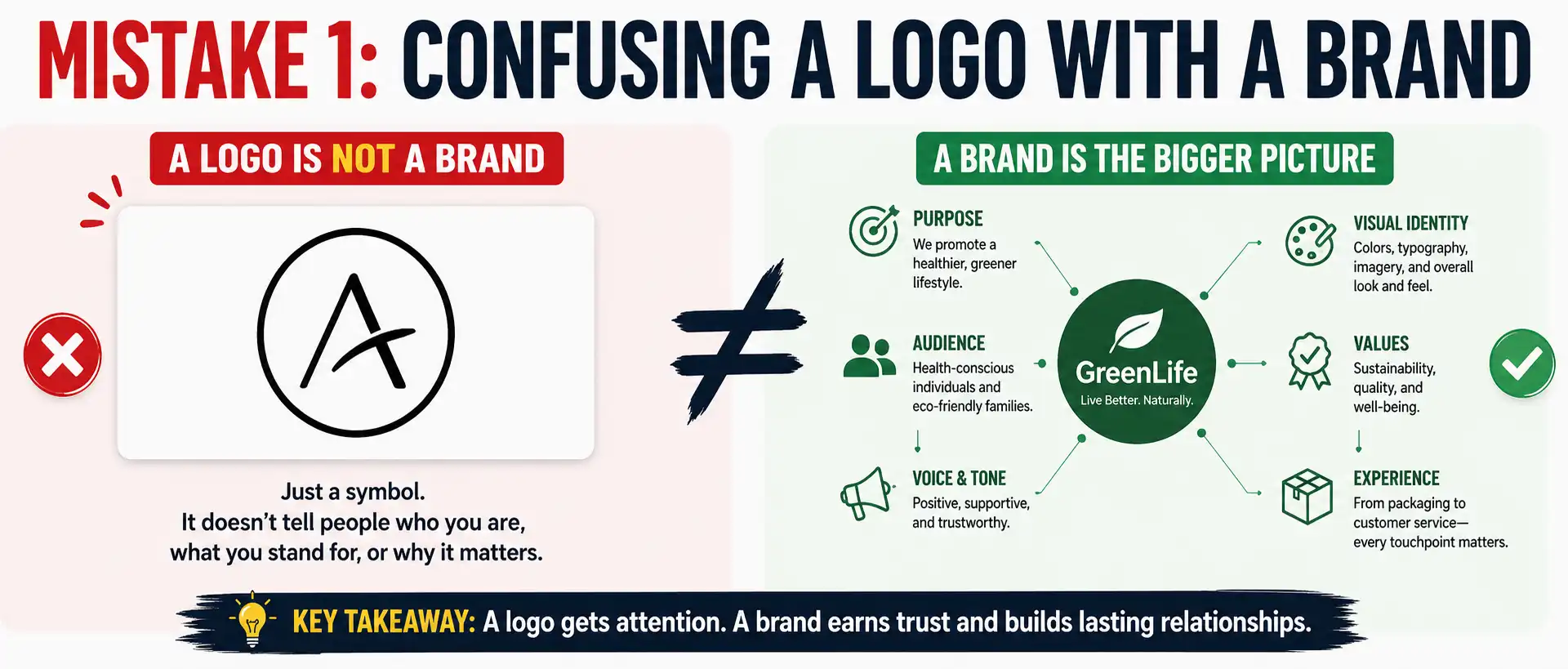
This is the most prevalent and most damaging misconception in small business branding. Many entrepreneurs believe that getting a logo designed means they have a brand. A logo is a single visual element and identifying mark. A brand is the complete system of perception that exists in the minds of your customers, shaped by every interaction they have ever had with your business.
You can have a beautifully designed logo and still have no coherent brand if your messaging is inconsistent, your visual identity varies from platform to platform, your customer service experience contradicts your marketing promises, and your employees cannot articulate what your company stands for.
The fix: Invest in brand strategy before visual identity. Define your purpose, positioning, personality, and values before you commission design work. The logo should be the expression of a brand that already exists in strategic form.
Mistake 2: Trying to Appeal to Everyone
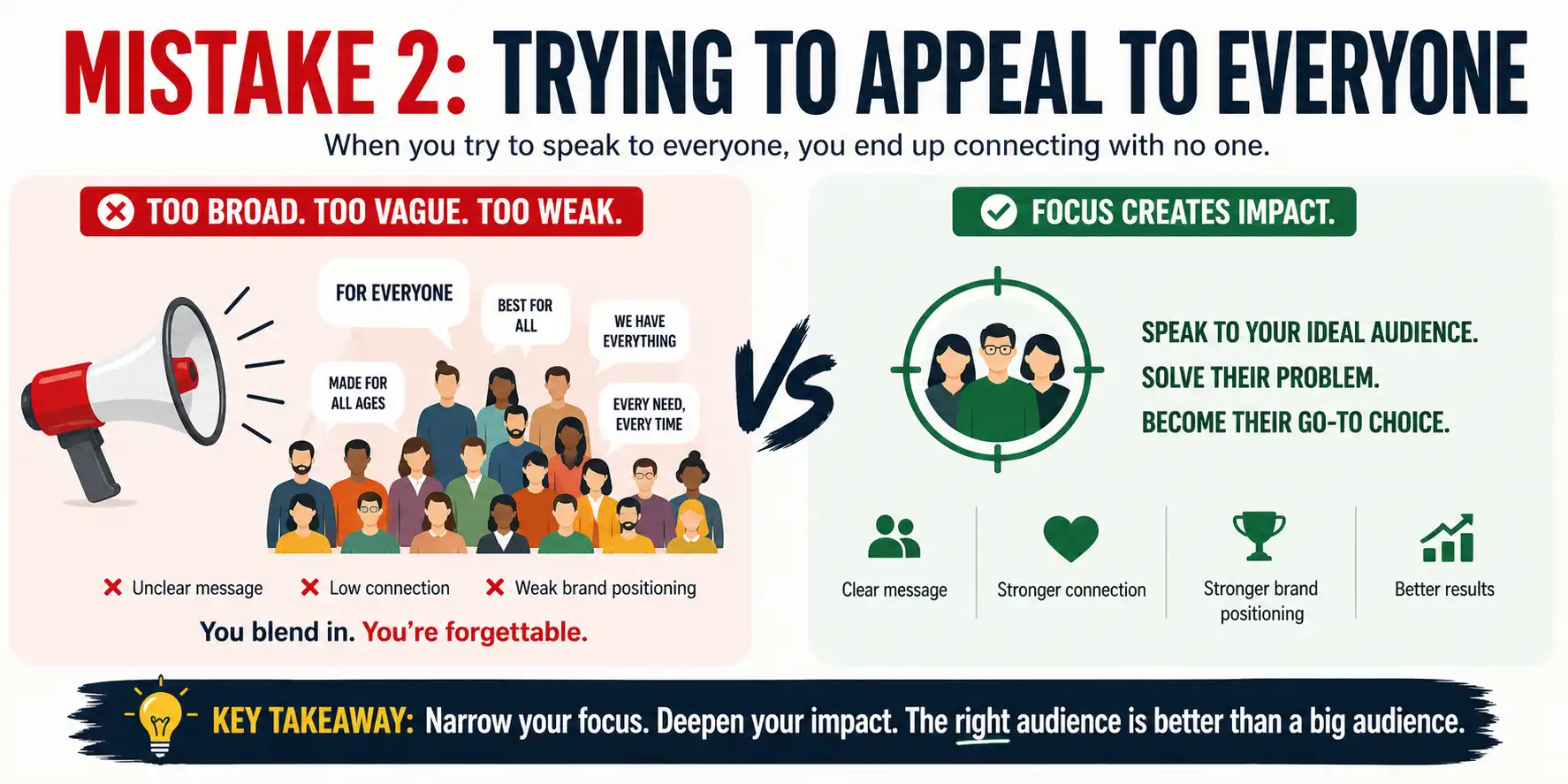
'Our product is for everyone' is a statement that guarantees marketing ineffectiveness. The most successful brands in every category are defined by the specificity of their audience focus, not the breadth of it. Red Bull is not for everyone who wants an energy drink it is for high-performance individuals who want to push beyond limits. Patagonia is not for everyone who wants outdoor clothing it is for environmentally conscious outdoor enthusiasts who refuse to compromise.
This specificity is not limiting it is amplifying. When a brand speaks directly and powerfully to a precisely defined audience, it creates resonance that broad, generic messaging never achieves. The paradox of niche targeting is that it almost always reaches more people effectively than mass targeting does.
The fix: Define your ideal customer with genuine specificity demographics, psychographics, values, pain points, media behaviour, and vocabulary. Design every brand element to connect powerfully with that specific person.
Mistake 3: Inconsistency Across Touchpoints
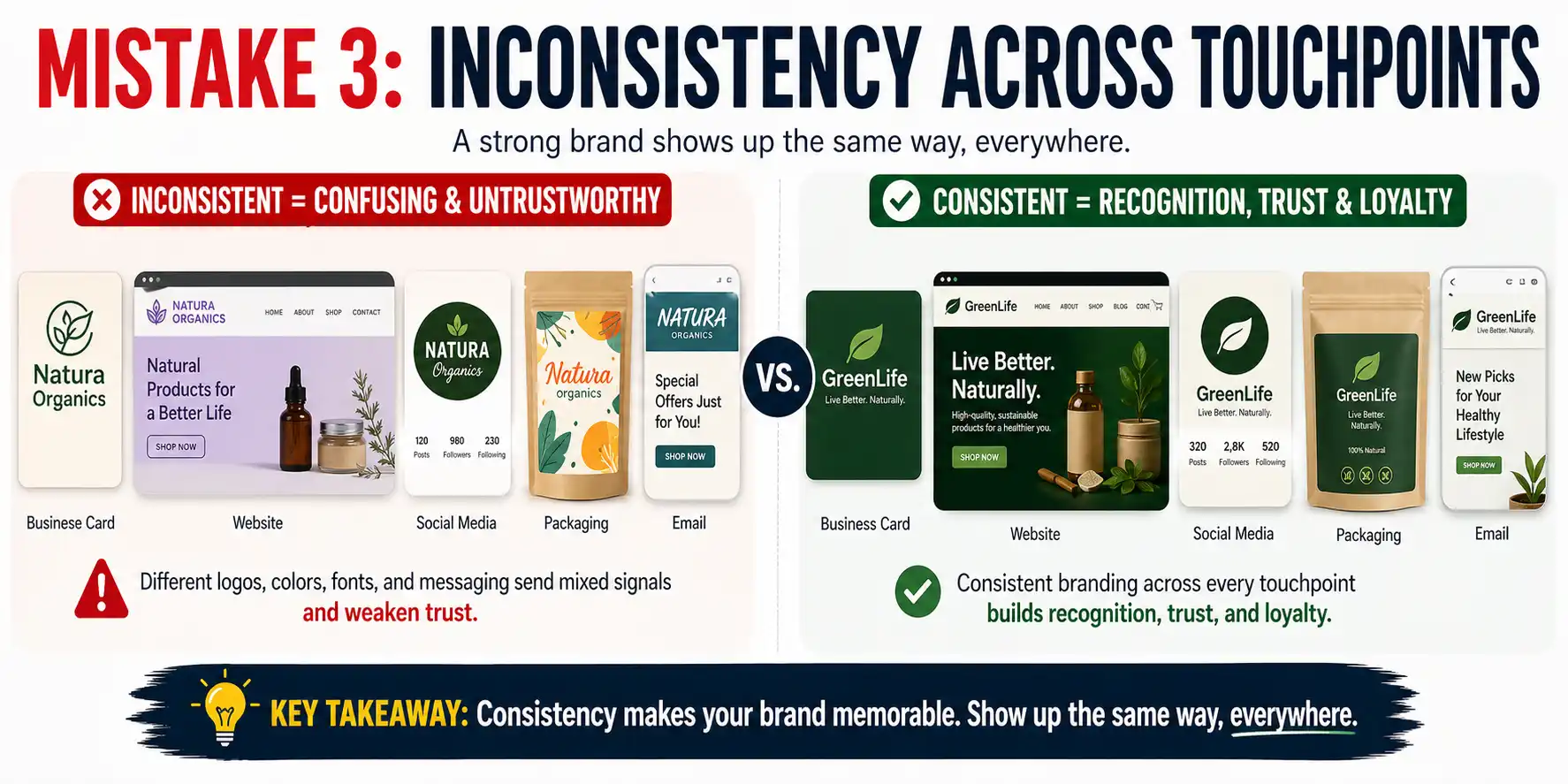
A brand that looks professional on its website but amateur on its social media, uses formal language in its proposals but casual language in its emails, and delivers premium packaging but poor after-sales service is not a coherent brand. It is a collection of disconnected impressions that fails to build the cumulative recognition and trust that drives loyalty.
Consistency is the mechanism through which brand identity becomes brand equity. Every consistent touchpoint reinforces the brand in the customer's memory. Every inconsistent touchpoint erodes it and creates cognitive dissonance.
Common inconsistency sources in small businesses:
Multiple logo versions used without system or discipline
Different color approximations used across different materials
Inconsistent tone of voice between marketing copy and customer service communication
Packaging or signage created by different designers without a shared guidelines document
Social media managed by multiple people without shared content guidelines
The fix: Create brand guidelines and enforce them. Make every team member, supplier, and agency who produces any brand-facing material aware of and accountable to your brand standards.
Mistake 4: Copying Competitor Branding
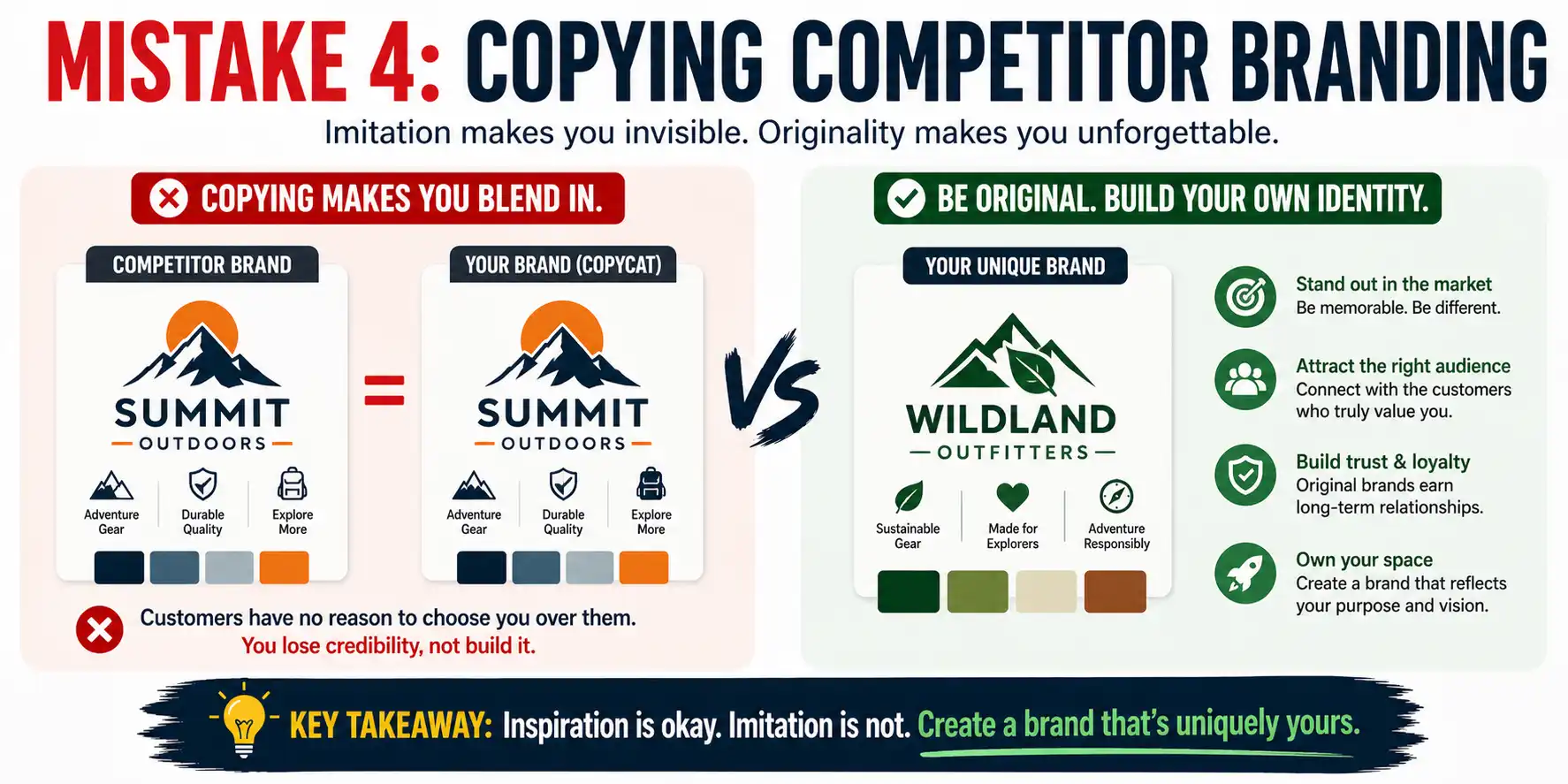
When small businesses look at the market leaders in their category and try to emulate their visual identity, they make a strategic error that is much worse than it first appears. Copying a competitor's color, logo style, or communication approach doesn't make customers think you are as good as the competitor it makes them think of the competitor.
Imitation branding is a guaranteed path to being perceived as a cheaper, lesser version of whatever brand you are imitating. In a category where you are competing against an established player with far greater resources, the last thing you want is to draw that direct comparison.
The fix: Research your competitors to understand the visual and communication territories they occupy then deliberately occupy different territory. Differentiation, not imitation, is the path to standing out.
Mistake 5: Prioritizing Trends Over Timelessness
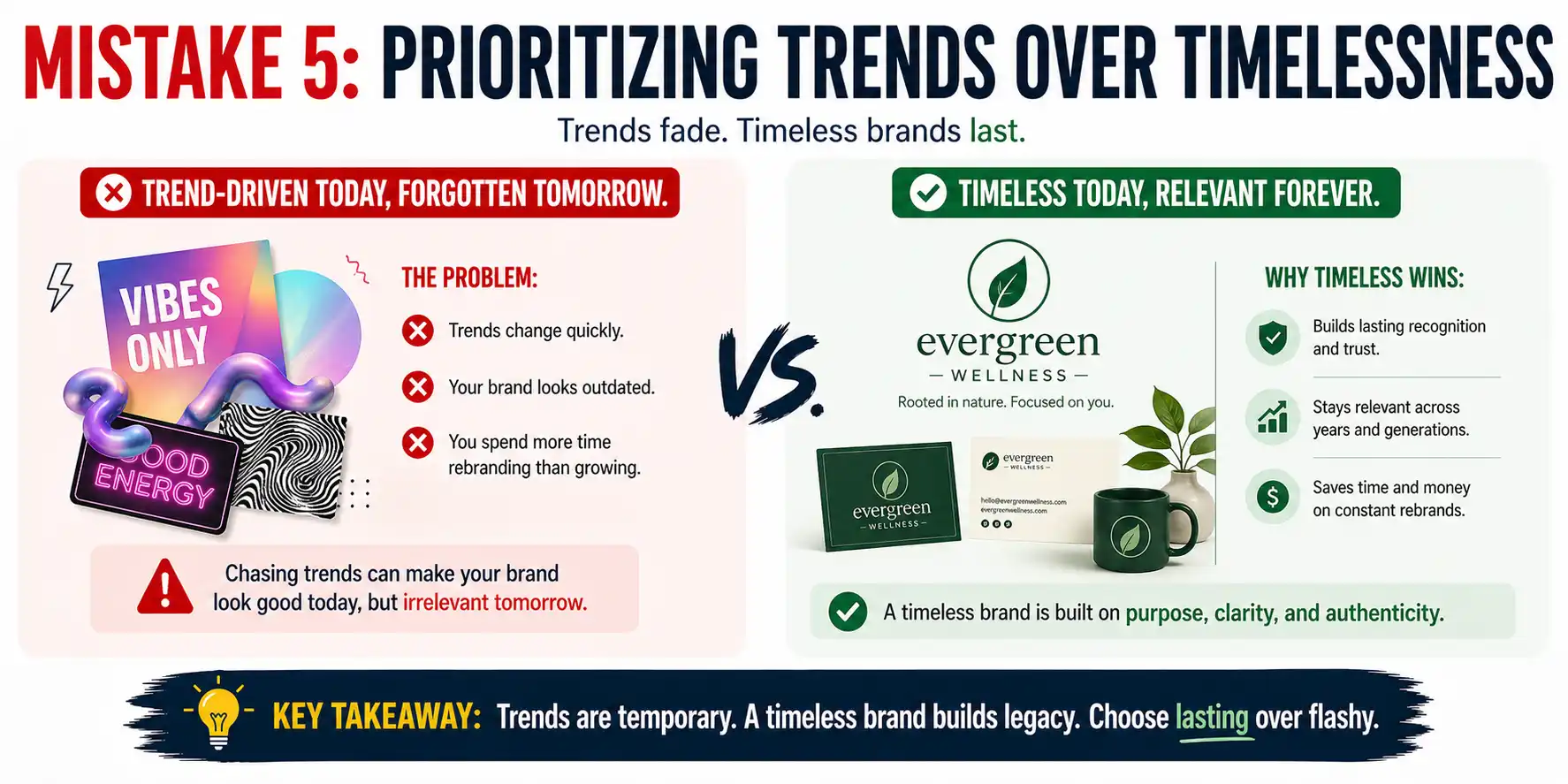
Every few years, a new design trend dominates brand identity work gradient logos, flat design, geometric sans-serifs, duotone photography, and so on. Small businesses that adopt these trends enthusiastically often find themselves with a brand identity that feels dated 3-5 years later and requires an expensive refresh.
The most durable brand identities are built on principles that transcend trends: strong typography, meaningful color choices, a distinctive and memorable mark, and a clear visual logic that allows the identity to evolve without losing its core recognition value.
The fix: Work with designers who demonstrate familiarity with both contemporary design and design history. Ask specifically: 'How will this look in ten years?' Trend-informed is acceptable; trend-dependent is a liability.
Mistake 6: Neglecting Brand Voice and Messaging
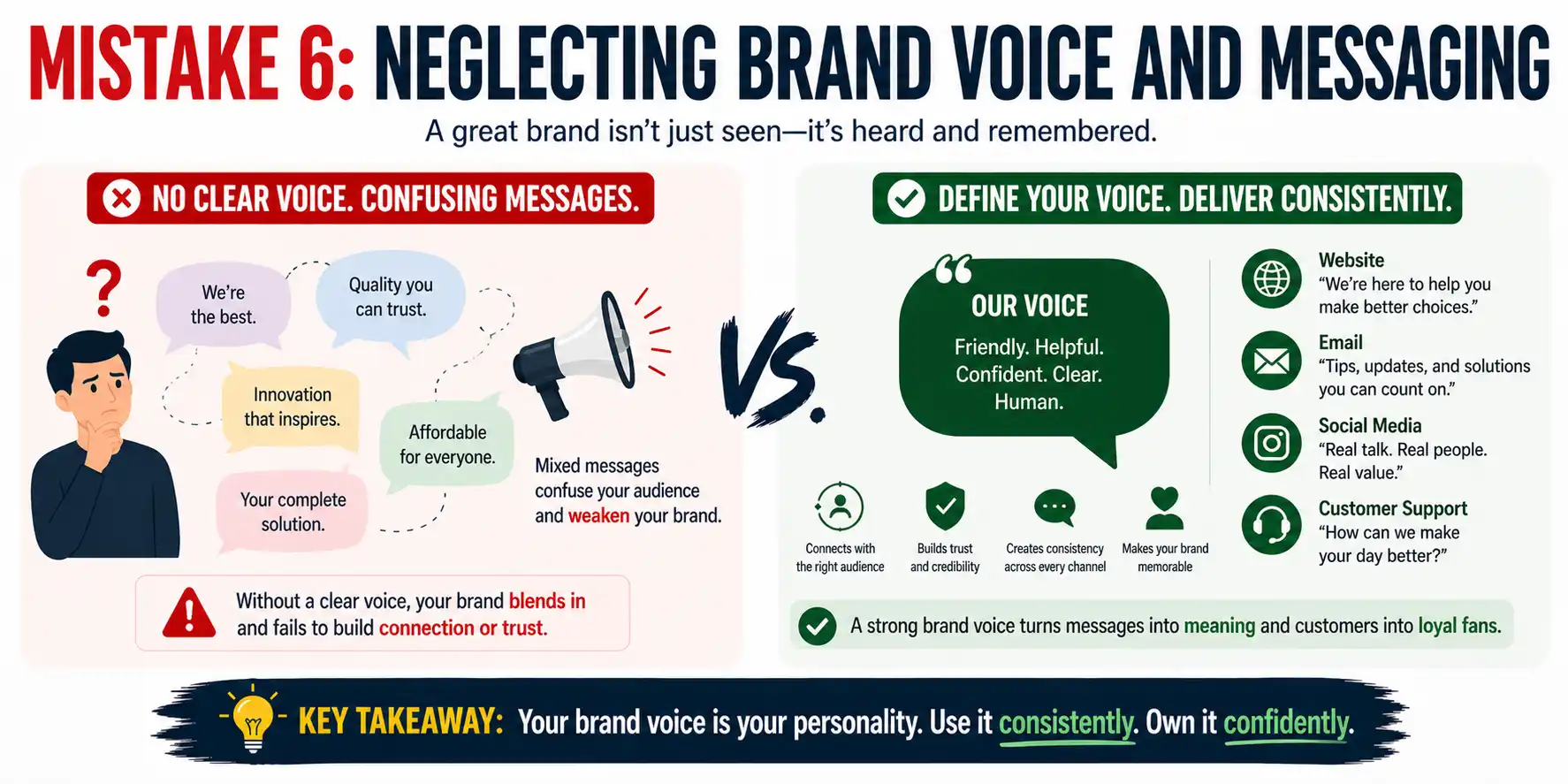
Most small business branding investment goes into visual identity. Very little goes into developing a coherent brand voice and this imbalance shows in business communication that is effective visually but forgettable or inconsistent verbally.
Your brand voice is present in every word your business produces: website copy, social media captions, email marketing, customer service responses, sales proposals, and even out-of-office messages. When this voice is not defined and consistently applied, these touchpoints fail to reinforce your brand personality and values.
The fix: Develop written brand voice guidelines that define tone, vocabulary preferences, communication principles, and before/after examples for your most common communication formats. Train anyone who writes on behalf of your brand in these guidelines.
Mistake 7: Skipping Professional Design to Save Money
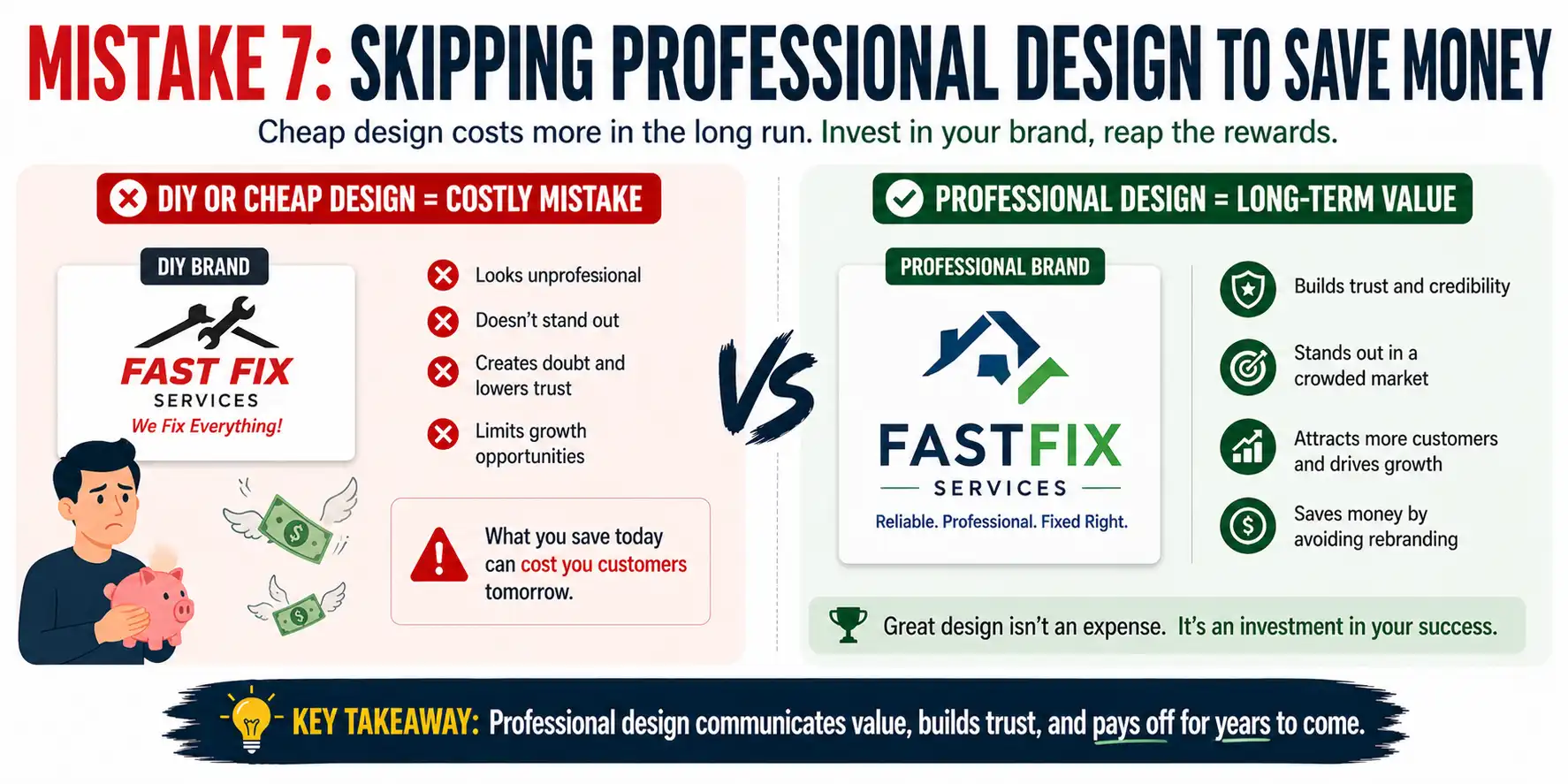
The 'I'll use a free logo maker for now and invest in proper design later' approach is one of the most expensive branding mistakes small businesses make. The problem is not the immediate cost saving it is the cumulative cost of the bad first impression delivered to every potential customer, partnership opportunity, investor, and recruit who encounters the amateurish identity.
In a digital world where anyone can see your brand within seconds of hearing about you, visual quality is a proxy for business quality. A poorly designed brand signals poor attention to detail, limited investment in the customer experience, and uncertain business stability.
The fix: Invest appropriately in professional brand design from the outset. If budget is genuinely limited, prioritise the core identity elements (logo system, color palette, key typography) and build out from there but invest in professional execution of these foundations.
Mistake 8: Not Having (or Following) Brand Guidelines
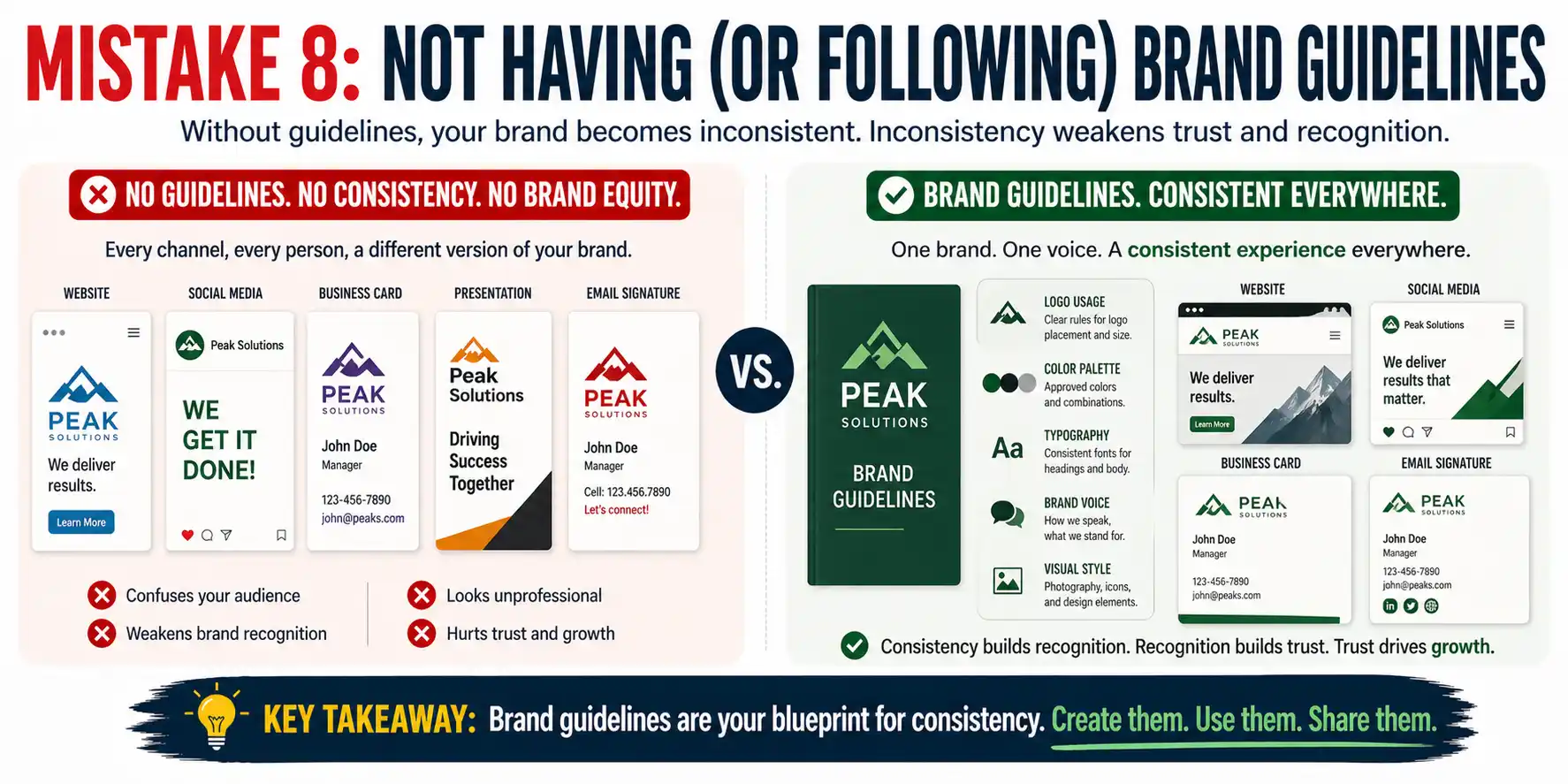
Even businesses that invest in professional brand identity design often fail to document it properly. Without a brand guidelines document, the carefully designed identity begins to drift the moment it is handed over. Different designers use different color approximations. The logo gets stretched, recolored, or cropped inappropriately. New team members make creative decisions without reference to brand standards.
The fix: Insist that any brand identity project delivers a comprehensive brand guidelines document as a core deliverable. Store this document accessibly (not buried in an email thread) and reference it actively when commissioning or reviewing any brand material.
Mistake 9: Failing to Evolve the Brand Over Time
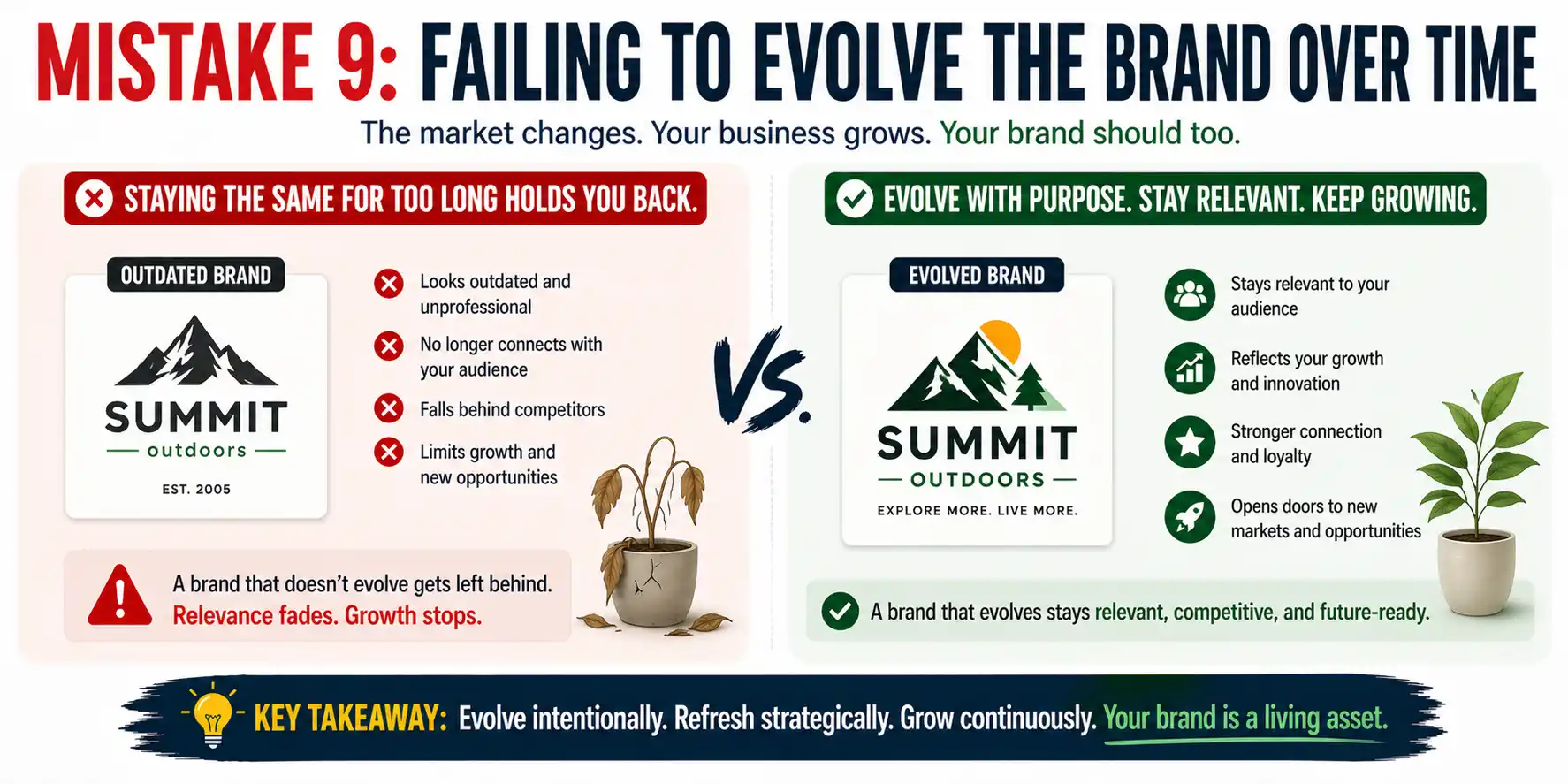
Brand identities need to evolve to remain relevant. Markets change, audiences change, culture changes, and a brand that was perfectly positioned at launch may need refinement 5-10 years later to remain fresh and competitive. The fear of inconsistency or the cost of a rebrand leads many businesses to maintain identities that have become dated, misaligned, or simply tired.
The best brand evolutions maintain the core recognition elements that carry equity while refreshing the elements that have become dated. Apple has evolved its logo, typeface, and visual language multiple times without losing the brand recognition it built over decades. The key is evolution, not revolution and it should be driven by strategic review, not aesthetic whim.
The fix: Conduct a structured brand audit at least every 3 years. Assess whether your brand identity remains aligned with your current market positioning, audience, and competitive context. Evolve proactively rather than reactively.
Mistake 10: Ignoring Online Brand Presence
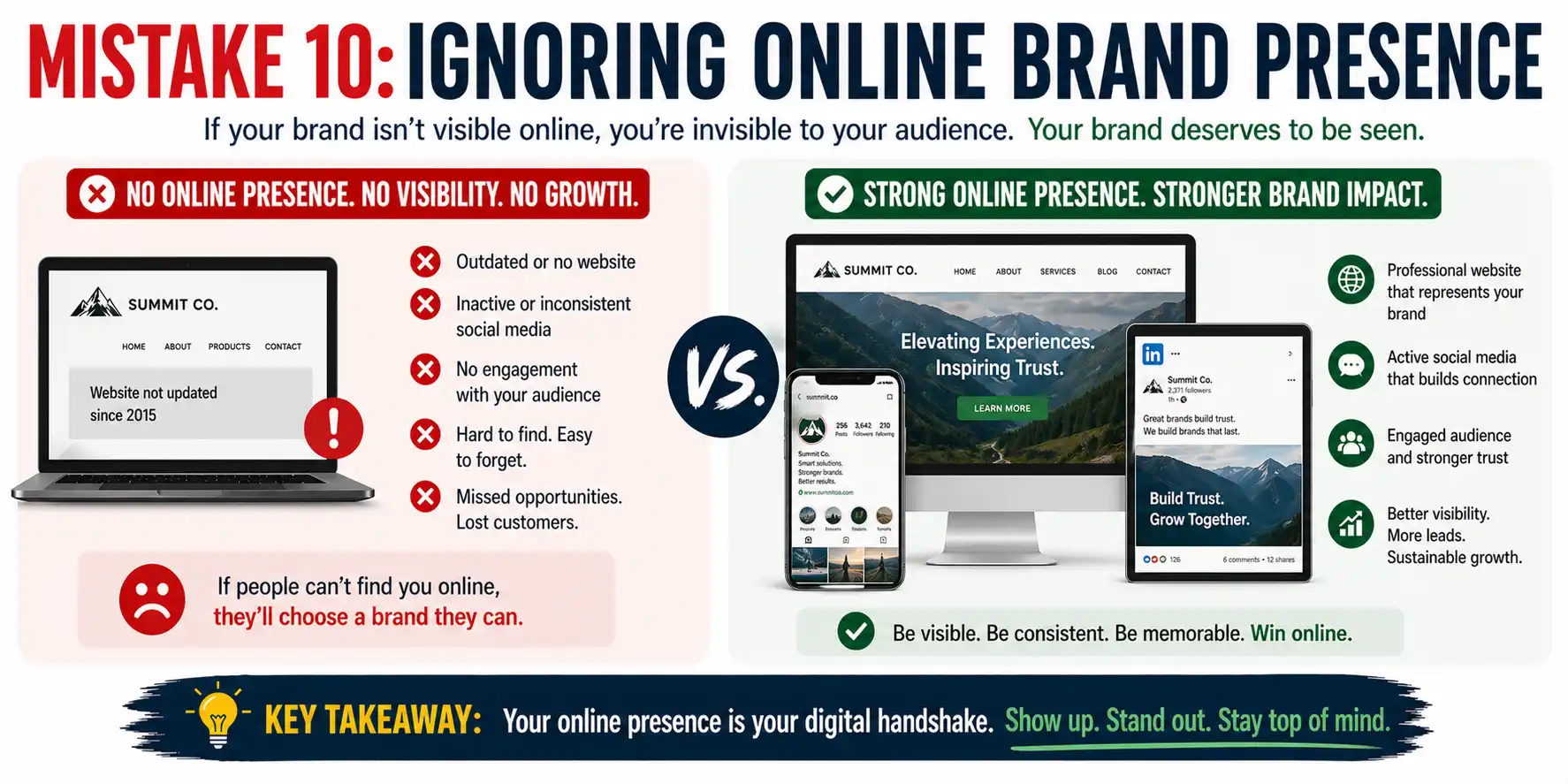
In 2026, a brand exists primarily in digital space. A beautiful printed brochure and professional business cards are valuable, but they reach a tiny fraction of the audience that your website, social media profiles, Google Business Profile, and online reviews reach every day. Small businesses that invest heavily in physical brand materials but neglect their digital brand presence are fighting the wrong battle.
Key digital brand touchpoints that are frequently neglected:
Google Business Profile with outdated information, no photos, or no review responses
Social media profiles with mismatched or low-quality profile images and cover photos
Websites with inconsistent visual identity, poor typography, or outdated content
Email signatures that do not reflect brand standards
Online directory listings with inconsistent business name, address, and phone number
The fix: Audit your complete digital brand presence systematically. Ensure every platform where your brand appears reflects your brand standards, is kept current, and actively serves your brand positioning.
Conclusion
Branding mistakes are costly not always in obvious, immediate ways, but in the cumulative loss of recognition, trust, differentiation, and customer loyalty that strong brands deliver. The businesses that avoid these common pitfalls and invest in building coherent, consistent, and strategically grounded brand identities are the ones that compete on the strength of their brand rather than solely on price.
The encouraging truth is that every mistake on this list is correctable. Wherever your brand stands today, clarity of strategy, commitment to consistency, and investment in professional execution can transform its effectiveness.
💡 Think your brand might be making some of these mistakes? Let's conduct a brand audit and identify exactly where the opportunities are contact us for a free brand review.


Comments